
You are here: Home


Key Publications
10 Years On
Guide to the guidelines
Model NCP
OECD Watch factsheets
 

OECD Watch is an international network of civil society organisations promoting corporate accountability. The purpose of OECD Watch is to inform the wider NGO community about policies and activities of the OECD's Investment Committee and to test the effectiveness of the OECD Guidelines for Multinational Enterprises.


OECD Watch statement on the update of the OECD Guidelines for Multinational Enterprises

Improved content and scope, but procedural shortcomings remain

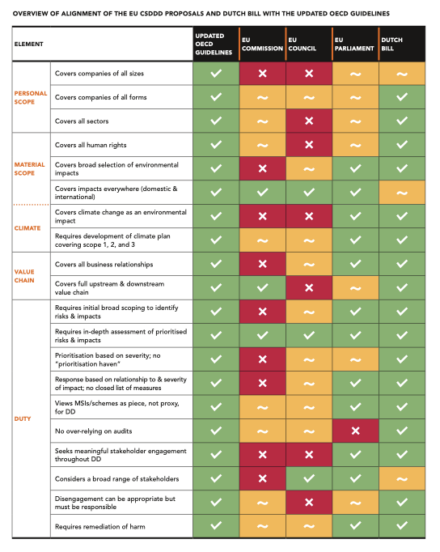
The updated OECD Guidelines for Multinational Enterprises, adopted on 25 May 2011, introduce important new provisions on human rights, workers and wages, and climate change. OECD Watch's “Statement on the update of the Guidelines” nevertheless concludes that procedural shortcomings remain, and therefore the Guidelines potential to become an effective and credible instrument for corporate accountability remains in question.

Go to the statement in English, Spanish and French


What's new?


Best Practices: Comparing National Contact Points

Best Practices: Comparing National Contact Points
29 03 2012
European Center for Constitutional and Human Rights (ECCHR) carried out a comparison “peer review” based on its OECD Guidelines complaints against 7 cotton traders from France, Germany, Switzerland and the United Kingdom for knowingly profiting from (forced) child labour in the Uzbek cotton industry.


Parties reach agreement in OECD Guidelines case regarding Nidera’s human rights policies and practices in Argentina

Parties reach agreement in OECD Guidelines case regarding Nidera’s human rights policies and practices in Argentina
05 03 2012
In the context of an OECD Guidelines case, the NGOs CEDHA, INCASUR, Oxfam Novib and SOMO have reached an agreement with the Netherlands-based agricultural MNE Nidera regarding the company’s human rights policies and practices. As part of the agreement, Nidera strengthened its human rights policy, formalised human rights due diligence procedures for temporary rural workers, and allowed the NGOs to monitor its Argentine corn seed operations through field visits.


Norwegian Nickel Controversy

Norwegian Nickel Controversy
04 01 2012
The Norwegian NCP issues its final statement regarding the complaint filed by Framtiden i våre hender against Norway-based Intex Resources for violating indigenous peoples’ human and environmental rights in 2009. In its final statement the Norwegian NCP concludes that Norwegian-owned Mindoro Nickel Project in the Philippines should consult a broader group of indigenous peoples and be more transparent about adverse environmental impacts.


What business should know about the OECD Guidelines

30 08 2011
There are a few core changes to the OECD Guidelines for Multinational Enterprises that companies must take heed of. OECD Watch elaborates on the opportunities to hold companies to account for their misconduct via the new due diligence, supply chain and human rights provisions in the new Guidelines.


Succesfull mediation in OECD Guidelines complaint against Cermaq

16 08 2011
In May 2009 ForUM and Friends of the Earth Norway filed a complaint against Cermaq ASA for multiple breaches of the Guidelines arising from the fish farming and fish feed operations of the company's subsidiary Mainstream. Following the successful conclusion of the mediation process and the joint statement by the complainants and the company the Norwegian NCP concluded the complaint in August 2011.


Document Actions

Personal tools
   OECD Watch is hosted by