News 2009
Chile signs up as first OECD member in South America
Chile will become the OECD’s 31st member and its first in South America under an accession agreement signed on 11 January at La Moneda in Santiago by OECD Secretary-General Angel Gurría and Chilean Finance Minister Andrés Velasco in the presence of President Michelle Bachelet. Chile’s membership will become official once necessary formalities, including parliamentary approval, have been completed.
Case alert: Human rights violations at Goldcorp's gold mine in Guatemala
A coalition of community groups from San Miguel Ixtahuacán, Guatemala filed an OECD complaint with the Canadian NCP, requesting an investigation into human rights violations committed by Goldcorp Inc. at the company's Marlin gold mine.
Workshop on the revision process on the OECD Guidelines for Multinational Enterprises
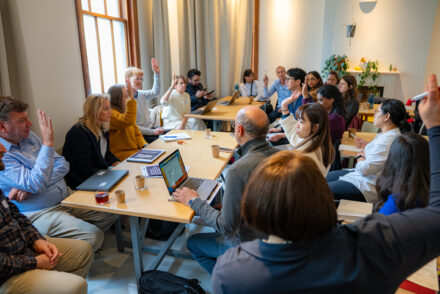
On 24 November 2009 several Argentinian NGOs held a workshop to reflect and discuss the process of revising the OECD Guidelines for Multinational Enterprises by several Argentinian NGOs.
Case alert: Massive layoffs at Triumph factories in Thailand and the Philippines
A union delegation from Thailand and the Philippines filed a complaint at the Swiss NCP against Triumph for massive layoffs without prior consultation with the unions at garment factories in Thailand and the Philippines.
Morocco joins the OECD Declaration on International Investment
Morocco has joined 41 other countries in signing the OECD Declaration on International Investment and Multinational Enterprises, in a move that commits it to supporting an open environment for international investors and encouraging responsible investment by multinational companies as a means to promote prosperity and growth.
Case alert: Controversial business practices by Vattenfall's subsidaries in Germany
On October 29 2009 Greenpeace Germany has lodged an OECD Guidelines complaint at the German NCP against Vattenfall AB and its German subsidiaries Vattenfall Europe AG, Vattenfall Europe Generation AG & Co. KG and Kernkraftwerk Kruemmel GmbH & Co. oHG for violations concerning environmental policies, consumer protection, disclosure and unreasonable lobbying by the company in Germany.
OECD Watch’s recommendations on the framework proposed by the SRSG on Business and Human Rights
This OECD Watch paper provides a contribution to the current international debate on business and human rights, with a specific focus on the relationship between the OECD Guidelines for Multinational Enterprises and the ‘Ruggie mandate’. The likely review of the OECD Guidelines in 2010 will provide an opportunity to strengthen human rights elements of the OECD Guidelines and contribute to the ‘operationalisation’ of the framework developed by John Ruggie, Special Representative to the United Nations Secretary General (SRSG) on Business and Human Rights.
ANNOUNCEMENT Corporate Accountability: Tools to Promote Responsible Business Conduct
OECD Watch and The Diplomacy Training Program have partnered to deliver the forthcoming regional capacity building program on Corporate Accountability: Tools to Promote Responsible Business Conduct. The program has been developed to assist civil society and community leaders to actively engage in the social, environmental and human rights challenges posed by the influence of corporations, particularly multi-national enterprises in the region.
New Quaterly Case Update Autumn 2009 available
Autumn 2009 update of pending and recently concluded or rejected cases, new cases filed and current case statistics.
ANNOUNCEMENT: OECD Watch Side event OHCHR Consultation on business and human rights
OECD Watch will organise a lunchtime side event at the OHCHR Consultation on business and human rights: Operationalizing the “Protect, Respect, Remedy” framework that will be held in Geneva. The side event will explore the Guidelines’ potential to contribute to the Ruggie framework. OECD Watch will encourage professor Ruggie and his team to engage with the OECD and member states in upgrading the Guidelines and create synergy towards a more effective and accountable business and human rights framework.
OECD Guidelines lack teeth, influence
The OECD Guidelines for Multinational Enterprises are expectations of adhering countries with regard to responsible behaviour of their multinational corporations on Corporate Social Responsibility (CSR) issues labour and human rights and the environment. The Guidelines are voluntary, companies are not required to abide by them. The closure of an OECD Guidelines case against Shell this week once again reveals that the voluntary nature of the Guidelines and governments’ reluctance to place consequences on breaches of the Guidelines limit the instrument’s authority and ability to influence corporate conduct.
Purchasing power and responsible business conduct
The OECD 2009 conference on corporate responsibility—“Consumer Empowerment and Responsible Business Conduct” provided an opportunity to consider not only, the role of private consumers and their growing demand for sustainable products and corporate transparency, but also, the role of public authorities in their procurement of both goods and services. Further, the likely review of the OECD Guidelines for Multinational Enterprises (The Guidelines) in the near future makes an assessment of the Consumer Interests (chapter 7) timely. OECD Watch contributed to the OECD conference, and this article highlights some of the issues raised.
Human Rights, Advocacy and Business – Capacity Building in Thailand
The Diplomacy Training Program (DTP) in partnership with the Institute for Social and Economic Change and Cividep, India (an OECD Watch member), recently held its fourth regional program on human rights advocacy and business in Chiang Mai, Thailand. The program was originally scheduled to be held in Bangalore.
OECD Forum 2009 – The Crisis and Beyond
June 2009 was a particularly busy time for the OECD. The OECD Forum 2009 and the Ministerial Council meeting followed ‘hot on the heels’ of the Investment Committee annual conference on CSR, and meeting of National Contact Points.
Toward parent company and home country responsibility in OECD Guidelines cases
In his April 2009 report to the UN Human Rights Council, Professor John G. Ruggie, Special Representative of the UN Secretary-General on business & human rights, highlighted the “increase in civil cases brought against parent companies for their acts and omissions in relation to harm involving their foreign subsidiaries”. The acknowledgement that parent companies must take responsibility for the actions and activities of their subsidiaries around the world is also beginning to play out in the arena of the OECD Guidelines for Multinational Enterprises and the Specific Instance procedure.
2009 Annual Review on NCPs available
Each year in preparation for the Annual Meeting of National Contact Points (NCPs) in June, OECD Watch evaluates the functioning of the OECD Guidelines for Multinational Enterprises (Guidelines) and NCPs and their effectiveness in enhancing responsible business conduct.
Dutch NCP issues final statement on OECD complaint against Shell
The Dutch NCP has published its final statement on the complaint that Fenceline Community and Friends of the Earth Netherlands have filed against Royal Dutch Shell's practices concerning the Pandacan oil depot in Manila, the Philippines.
Niza calls for the immediate release of transparency activist Golden Misabiko
Golden Misabiko, Chair of the African Association for the Protection of Human Rights (ASADHO) in Katanga, was arrested on 24 July and remains in custody in Lubumbashi. Timothée Mbuya, Vice-Chair of ASADHO/Katanga, was also arrested on 24 July but subsequently released on the same day.
Global Witness uncovers foreign companies’ links to Congo violence
This new report by Global Witness, entitled ‘Faced with a gun, what can you do?’, details how companies are buying from suppliers who trade in minerals from the warring parties. Many mining areas in eastern DRC are controlled by rebels and the national army, who violently exploit civilians to retain access to valuable minerals, including cassiterite (tin ore), coltan and gold. Cassiterite and coltan are used to make mobile phones, computers and other electronics, among other things.
The OECD Guidelines received prominent international support by the European Women Lawyers Association
The European Women Lawyers Association upheld the importance of the OECD Guidelines and made specific recommendations for strengthening their implementation