50 years of the OECD Guidelines: Contributions, limitations, and what is needed next
Recommendations for the OECD and member governments on the future implementation of the Guidelines



OECD Watch works with members and partners to strengthen corporate accountability for harms linked to technology and artificial intelligence (AI).
We help advise claims related to technology, helping communities and workers seek justify for related harms. We also encourage knowledge building for NCPs and governments on this issue.
We fought successfully for improved standards on technology and digitalisation in the latest revision of the OECD Guidelines. We also contributed to the development of the OECD’s Responsible AI Supply Chains Guidance and its accompanying online tool, working with members and partners focused on technology and AI to reflect more civil society priorities in the guidance.
We were disappointed that the final guidance does not identify the wide range of human rights and environmental risks associated with AI. This is a significant gap as reliance on AI continues to grow. At the same time, the guidance makes an important contribution by framing AI due diligence through the OECD’s broader risk-based, six-step approach to responsible business conduct.
As OECD Watch tracks development of responsible business conduct law and policy, we will focus on promoting coverage of digitalisation or AI-related impacts occurring both upstream and downstream in a company’s value chain.

The OECD Guidelines call on companies to conduct due diligence on the actual and potential impacts of science, technology and innovation. Companies should:
The Guidelines are designed to remain relevant as technology develops. Companies should therefore consider emerging and reasonably foreseeable risks rather than limiting due diligence to harms that are already well understood.
In 2026, the OECD published Due Diligence Guidance for Responsible AI. It provides guidance to companies for implementing the OECD Guidelines’ standards on responsible business conduct and the OECD AI Principles when developing and using artificial intelligence.
Want to learn more about OECD Watch’s work on this issue? Get in touch with us to find out more about our advocacy and resources, or to discuss how the OECD Guidelines can support your work. Reach out directly.
Get a practical overview of what the OECD Guidelines say about taxation. Available in:


Explore the OECD’s due diligence guidance for responsible AI supply chains, including the online tool that dives into the existing and emerging risks in the sector.

See complaints in which technology issues have been raised by civil society.

The OECD Guidelines provide civil society with a framework for engaging companies, governments and other decision-makers on responsible business conduct. You can use the Guidelines to:
Help communities and other affected people understand the standards companies are expected to meet and the rights and protections they can demand.
Use the Guidelines to talk to companies about their impacts and demand that they prevent, address and remedy harm.
Use the Guidelines to advocate for strong laws, policies and corporate practices that protect people and the planet and hold companies accountable.
When a company falls below the standards in the Guidelines, you can bring a complaint to an NCP and seek accountability and remedy.

A new OECD Due Diligence Guidance for Responsible AI falls short of expectations, but still provides a useful resource. During the 2023 revision of the OECD Guidelines, OECD Watch members fought hard for new expectations…

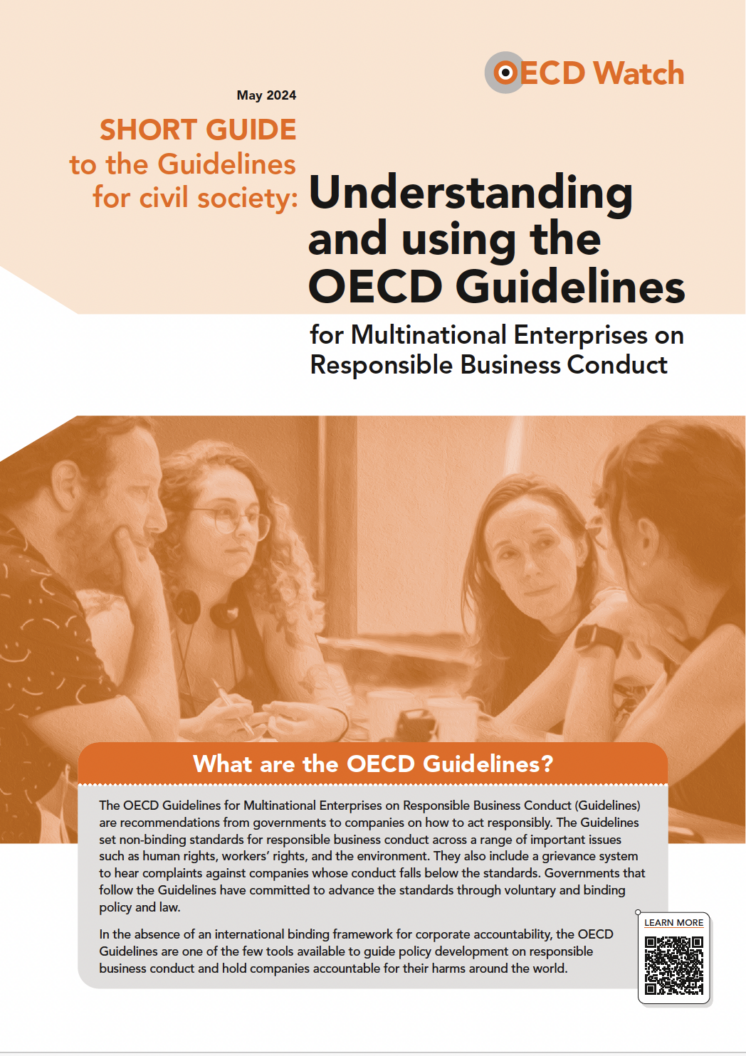

By Shreeja Sen Blog symposium co-organised by OECD Watch and NOVA School of Law Increasing digitalisation has spawned a system-wide disruption resulting in a reorganisation of production on a global to local scale. This…