


Irresponsible conduct is in no one’s interest
Businesses, consumers, and governments are simultaneously realising what impacted people have always known – that irresponsible business conduct can no longer be tolerated.
- Companies are learning that climate-blind, polluting, human rights-abusive, and corrupt practices in their value chains cause them real operational, clean-up, reputational, and consumer confidence costs.
- Consumers increasingly don’t want products they know are made through environmental degradation and worker abuse.
- Governments recognise that to save the planet and preserve functioning societies in future, they must ensure corporations do their part to prevent climate change and support sustainable and inclusive development.
- Impacted people and civil society know that planetary and social wellbeing depend on businesses respecting their rights and environments.
We all know that a new and responsible way of doing business is essential. So how do we get there?
How the OECD Guidelines help
The OECD Guidelines establish valuable recommendations on responsible business conduct. They’re not perfect, and OECD Watch is always pushing for improvement. But they set a strong baseline.
And though the Guidelines are voluntary, companies increasingly follow them – because they work. They are comprehensive in scope, flexible to each circumstance and, if genuinely followed, effective in supporting prevention, mitigation, and remedy of harm. They are also widely known globally, backed by governments, and endorsed by business, unions, and civil society.
As governments pursue corporate accountability law, they are increasingly using the OECD Guidelines as a blueprint or model. In fact, in their 2022 Recommendation on the Role of Government in Promoting Responsible Conduct, OECD governments encouraged each other to adopt legal and regulatory frameworks for responsible business conduct aligning with the OECD Guidelines and due diligence guidance.
Aligning laws with the Guidelines
In recent years, governments have been using varying legal approaches to require corporate accountability – from banning products made irresponsibly such as with forced labour, deforestation, or corruption; to seeking disclosure of harms and response measures; to requiring human rights and environmental due diligence.
These approaches can sometimes seem in conflict. In fact, they can align well when implemented through the lens of the normative framework for responsible business conduct – namely through the lens of OECD Guidelines, UN Guiding Principles on Business and Human Rights, and ILO MNE Convention.
That’s why governments and the OECD are promoting coherence between the Guidelines and national, regional, and multilateral approaches to corporate accountability. Through an Inclusive Platform on Due Diligence Policy Cooperation, 70 governments are discussing best practice to ensure responsible business conduct through policy and law. They see the Guidelines as a key tool companies and governments can use to achieve impact, efficiency, and legal coherence globally.
What OECD Watch is doing
OECD Watch supports the deepening of the Guidelines’ voluntary standards into binding rules for companies. We support policy discussion on this topic at the OECD, and enable civil society to use the Guidelines’ standards as a reference point and the due diligence model as a framework to support parallel development of policy, law, and standards on corporate conduct.
Soyez impliqué(e)
Want to learn more about OECD Watch’s work on this issue? Get in touch with us to find out more about our advocacy and resources, or to discuss how the OECD Guidelines can support your work.
You can also join our civil society working group on due diligence legislative developments Pour collaborer avec des organisations œuvrant sur ce sujet, échanger des connaissances et contribuer à une action collective. Contactez-nous directement.
Ressources associées
Our work on supporting accountability rules
Nous soutenons la société civile et les décideurs politiques pour renforcer les règles d’obligation redditionnelle des entreprises et les cadres de conduite responsable des entreprises conformément aux lignes directrices de l’OCDE.
En utilisant l'OCDE Recommandation sur le rôle du gouvernement dans la promotion des RBC
Lisez le blog d’OECD Watch sur l’utilisation de la Recommandation pour encourager les progrès gouvernementaux dans le développement des BRC grâce à la législation ainsi qu’à des politiques concernant des sujets connexes tels que les marchés publics, les crédits à l’exportation ou le financement du développement.
Actualités et publications associées
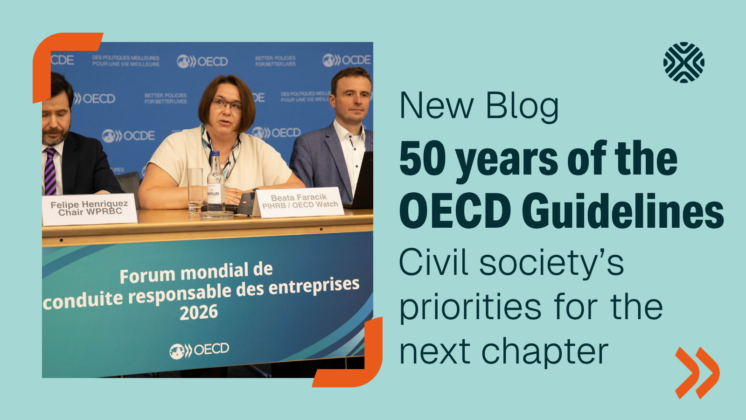
50 ans des Principes directeurs de l'OCDE : Les priorités de la société civile pour le prochain chapitre
La semaine dernière, l’organisation OECD Watch s’est jointe aux gouvernements, aux entreprises, aux syndicats et à la société civile du monde entier à Paris pour la Semaine de la Responsabilité des Entreprises de l’OCDE, qui marque le 50e anniversaire des Lignes directrices de l’OCDE pour les entreprises multinationales…
50 ans des Lignes directrices de l’OCDE : contributions, limites et ce qui est nécessaire à l’avenir
Recommandations pour l’OCDE et les gouvernements membres concernant la mise en œuvre future des lignes directrices
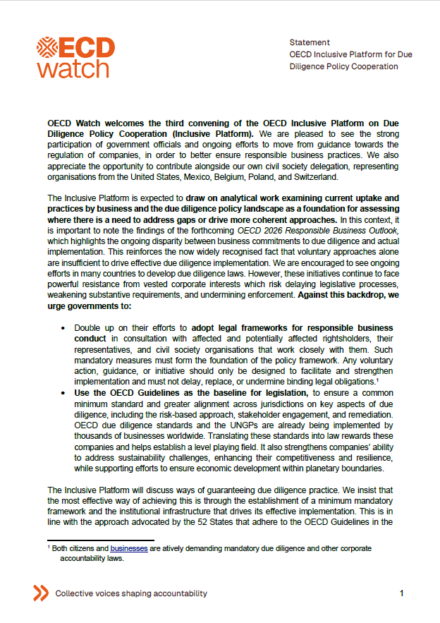
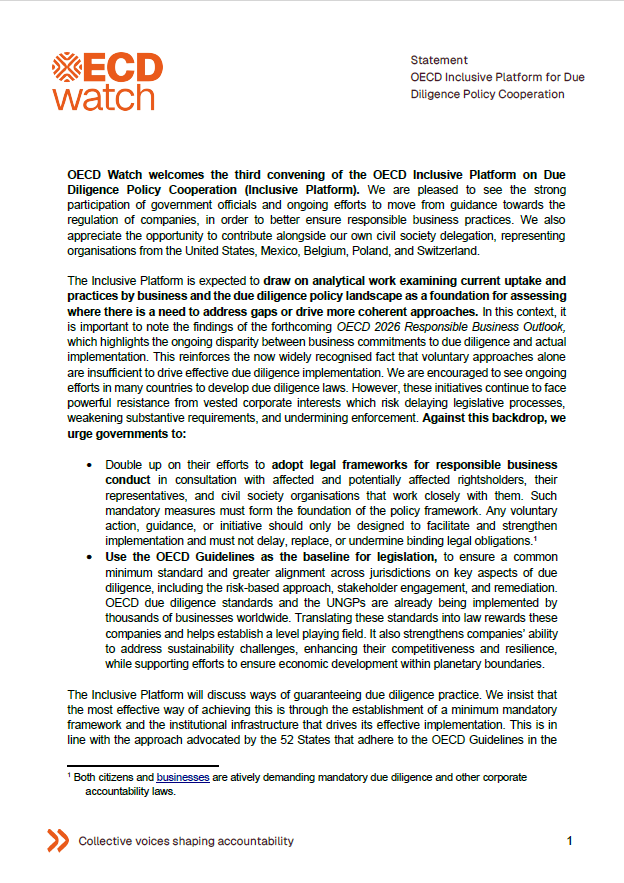
Déclaration de l'OCDE Watch sur l'avancement des cadres juridiques pour une conduite d'entreprise responsable
Déclaration sur la troisième réunion de la plateforme inclusive de l'OCDE sur la coopération en matière de politique de diligence raisonnable
Lettre ouverte aux membres du Groupe de travail de l'OCDE sur la conduite des entreprises responsables
OECD Watch s’est joint à plus de 100 organisations de défense des droits humains et environnementaux – dont des organisations représentatives des peuples autochtones et des peuples afro-descendants – issus de plus de 55 pays pour adresser une lettre ouverte aux membres du Conseil d’administration de l’organisation…
Lettre de signature auprès de l’IFC : aligner les normes de durabilité sur les lignes directrices de l’OCDE
OECD Watch a envoyé une lettre commune à la Société financière internationale (IFC) appelant à une révision de son cadre de développement durable afin qu’il soit aligné sur les lignes directrices de l’OCDE pour les entreprises multinationales sur la conduite responsable des affaires – ce qui représente une avancée considérable…