

Irresponsible conduct is in no one’s interest
Businesses, consumers, and governments are simultaneously realising what impacted people have always known – that irresponsible business conduct can no longer be tolerated.
- Companies are learning that climate-blind, polluting, human rights-abusive, and corrupt practices in their value chains cause them real operational, clean-up, reputational, and consumer confidence costs.
- Consumers increasingly don’t want products they know are made through environmental degradation and worker abuse.
- Governments recognise that to save the planet and preserve functioning societies in future, they must ensure corporations do their part to prevent climate change and support sustainable and inclusive development.
- Impacted people and civil society know that planetary and social wellbeing depend on businesses respecting their rights and environments.
We all know that a new and responsible way of doing business is essential. So how do we get there?

How the OECD Guidelines help
The OECD Guidelines establish valuable recommendations on responsible business conduct. They’re not perfect, and OECD Watch is always pushing for improvement. But they set a strong baseline.
And though the Guidelines are voluntary, companies increasingly follow them – because they work. They are comprehensive in scope, flexible to each circumstance and, if genuinely followed, effective in supporting prevention, mitigation, and remedy of harm. They are also widely known globally, backed by governments, and endorsed by business, unions, and civil society.
As governments pursue corporate accountability law, they are increasingly using the OECD Guidelines as a blueprint or model. In fact, in their 2022 Recommendation on the Role of Government in Promoting Responsible Conduct, OECD governments encouraged each other to adopt legal and regulatory frameworks for responsible business conduct aligning with the OECD Guidelines and due diligence guidance.
Aligning laws with the Guidelines
In recent years, governments have been using varying legal approaches to require corporate accountability – from banning products made irresponsibly such as with forced labour, deforestation, or corruption; to seeking disclosure of harms and response measures; to requiring human rights and environmental due diligence.
These approaches can sometimes seem in conflict. In fact, they can align well when implemented through the lens of the normative framework for responsible business conduct – namely through the lens of OECD Guidelines, UN Guiding Principles on Business and Human Rights, and ILO MNE Convention.
That’s why governments and the OECD are promoting coherence between the Guidelines and national, regional, and multilateral approaches to corporate accountability. Through an Inclusive Platform on Due Diligence Policy Cooperation, 70 governments are discussing best practice to ensure responsible business conduct through policy and law. They see the Guidelines as a key tool companies and governments can use to achieve impact, efficiency, and legal coherence globally.
What OECD Watch is doing
OECD Watch supports the deepening of the Guidelines’ voluntary standards into binding rules for companies. We support policy discussion on this topic at the OECD, and enable civil society to use the Guidelines’ standards as a reference point and the due diligence model as a framework to support parallel development of policy, law, and standards on corporate conduct.
¡Participa!
Want to learn more about OECD Watch’s work on this issue? Get in touch with us to find out more about our advocacy and resources, or to discuss how the OECD Guidelines can support your work.
También puedes unirte al grupo de trabajo de la sociedad civil de Due diligence en el ámbito legislativo Para conectar con organizaciones que trabajan en este tema, intercambiar conocimientos y contribuir a la promoción colectiva. Contacte con nosotros directamente.
Recursos relacionados
Our work on supporting accountability rules
Apoyamos a la sociedad civil y a los responsables políticos para fortalecer las normas de rendición de cuentas corporativa y los marcos de conducta empresarial responsable de acuerdo con los Lineamientos de la OCDE.
Policy coherence factsheet
Get a practical overview of what the OECD Guidelines say about advancing coherence across global RBC policy. Available in:

Inglés
Árabes
Français
Español
Portugalés
Usando el OEDC Recomendación sobre el papel del gobierno en la promoción de RBC
Lea el blog de OECD Watch sobre el uso de la Recomendación para fomentar el progreso gubernamental en el avance de la RBP mediante la legislación y la política en temas relacionados, como la contratación pública, los créditos para la exportación o la financiación del desarrollo.
Noticias y publicaciones relacionadas
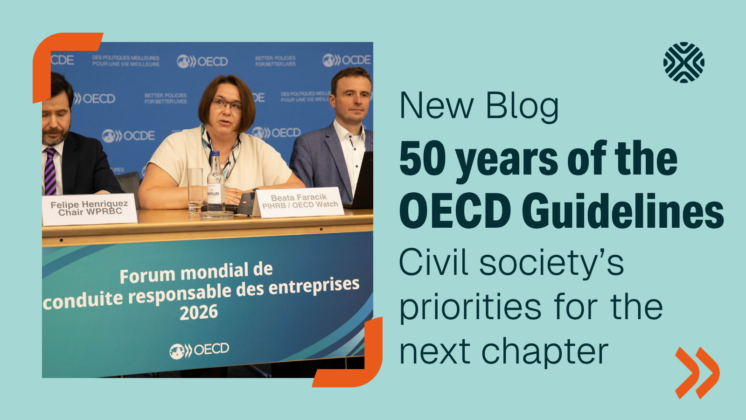
50 años de las Líneas Directrices de la OCDE: Las prioridades de la sociedad civil para el próximo capítulo
La semana pasada, OECD Watch se unió a gobiernos, empresas, sindicatos y la sociedad civil de todo el mundo en París para la Semana de Conducta Empresarial Responsable de la OCDE, que conmemora el 50º aniversario de las Directrices de la OCDE para las Multinacionales...

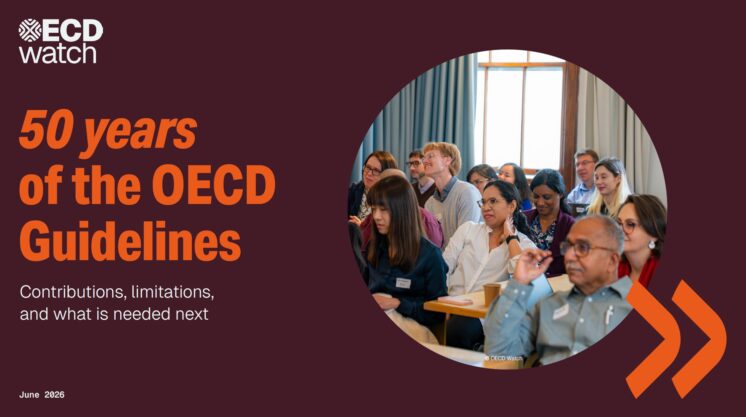
50 años de las Directrices de la OCDE: contribuciones, limitaciones y lo que se necesita a continuación
Recomendaciones para la OCDE y los gobiernos miembros sobre la futura implementación de las Directrices
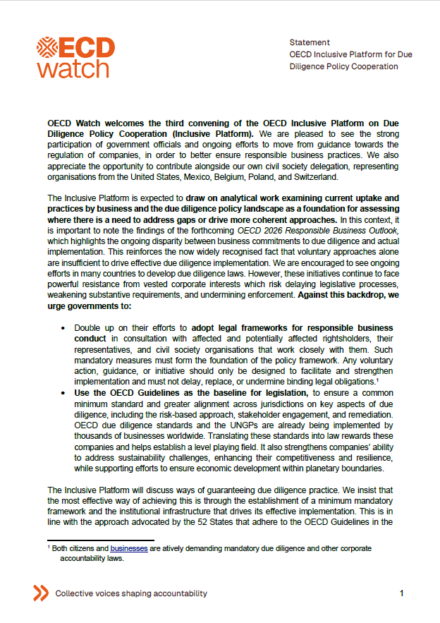
Declaración de la organización OECD Watch sobre el avance de los marcos legales para una conducta empresarial responsable
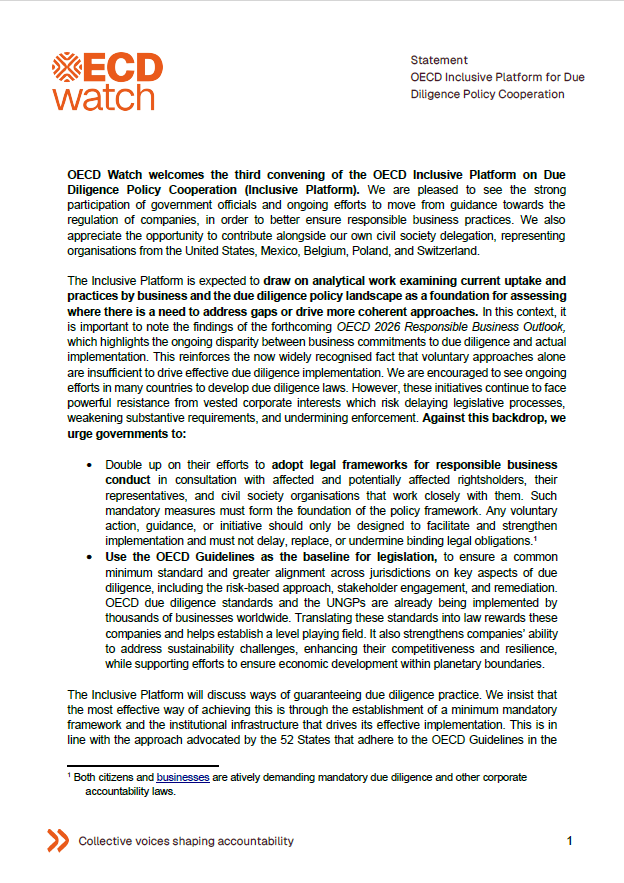
Declaración sobre la tercera reunión de la Plataforma Inclusiva de la OCDE sobre la cooperación en materia de políticas de diligencia debida
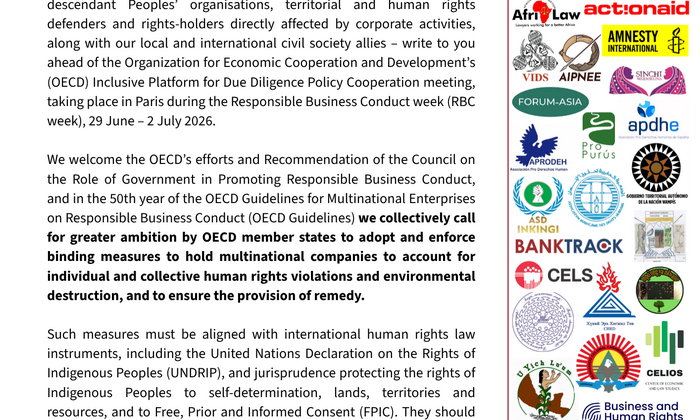
Carta abierta a los miembros del Grupo de Trabajo de la OCDE sobre Conducta Empresarial Responsable
OECD Watch se ha unido a más de 100 organizaciones de derechos humanos y ambientales –incluyendo organizaciones representativas de pueblos indígenas y afrodescendientes– de más de 55 países para enviar una carta abierta a los miembros de la…
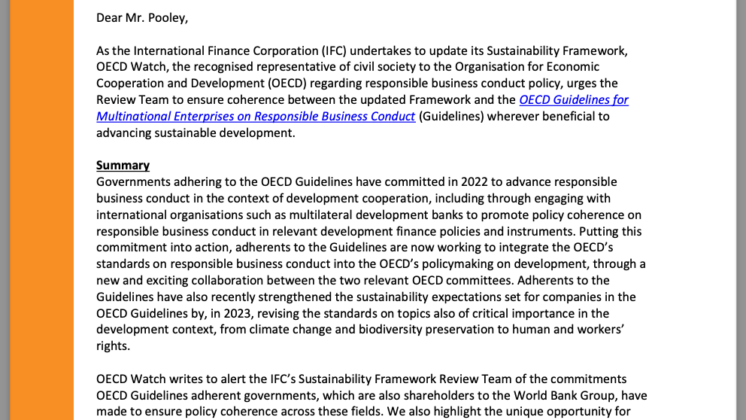
Carta de adhesión a la IFC: Alinear los estándares de sostenibilidad con las Directrices de la OCDE
OECD Watch ha enviado una carta conjunta a la Corporación Financiera Internacional (IFC) pidiendo que la revisión de su marco de sostenibilidad se ajuste a los Lineamientos de la OCDE para las Empresas Multinacionales sobre Conducta Empresarial Responsable – elevando la…