


Irresponsible conduct is in no one’s interest
Businesses, consumers, and governments are simultaneously realising what impacted people have always known – that irresponsible business conduct can no longer be tolerated.
- Companies are learning that climate-blind, polluting, human rights-abusive, and corrupt practices in their value chains cause them real operational, clean-up, reputational, and consumer confidence costs.
- Consumers increasingly don’t want products they know are made through environmental degradation and worker abuse.
- Governments recognise that to save the planet and preserve functioning societies in future, they must ensure corporations do their part to prevent climate change and support sustainable and inclusive development.
- Impacted people and civil society know that planetary and social wellbeing depend on businesses respecting their rights and environments.
We all know that a new and responsible way of doing business is essential. So how do we get there?

How the OECD Guidelines help
The OECD Guidelines establish valuable recommendations on responsible business conduct. They’re not perfect, and OECD Watch is always pushing for improvement. But they set a strong baseline.
And though the Guidelines are voluntary, companies increasingly follow them – because they work. They are comprehensive in scope, flexible to each circumstance and, if genuinely followed, effective in supporting prevention, mitigation, and remedy of harm. They are also widely known globally, backed by governments, and endorsed by business, unions, and civil society.
As governments pursue corporate accountability law, they are increasingly using the OECD Guidelines as a blueprint or model. In fact, in their 2022 Recommendation on the Role of Government in Promoting Responsible Conduct, OECD governments encouraged each other to adopt legal and regulatory frameworks for responsible business conduct aligning with the OECD Guidelines and due diligence guidance.
Aligning laws with the Guidelines
In recent years, governments have been using varying legal approaches to require corporate accountability – from banning products made irresponsibly such as with forced labour, deforestation, or corruption; to seeking disclosure of harms and response measures; to requiring human rights and environmental due diligence.
These approaches can sometimes seem in conflict. In fact, they can align well when implemented through the lens of the normative framework for responsible business conduct – namely through the lens of OECD Guidelines, UN Guiding Principles on Business and Human Rights, and ILO MNE Convention.
That’s why governments and the OECD are promoting coherence between the Guidelines and national, regional, and multilateral approaches to corporate accountability. Through an Inclusive Platform on Due Diligence Policy Cooperation, 70 governments are discussing best practice to ensure responsible business conduct through policy and law. They see the Guidelines as a key tool companies and governments can use to achieve impact, efficiency, and legal coherence globally.
What OECD Watch is doing
OECD Watch supports the deepening of the Guidelines’ voluntary standards into binding rules for companies. We support policy discussion on this topic at the OECD, and enable civil society to use the Guidelines’ standards as a reference point and the due diligence model as a framework to support parallel development of policy, law, and standards on corporate conduct.
Junte-se a nós
Want to learn more about OECD Watch’s work on this issue? Get in touch with us to find out more about our advocacy and resources, or to discuss how the OECD Guidelines can support your work.
You can also join our civil society working group on due diligence legislative developments Para se conectar com organizações que trabalham com esse tema, trocar conhecimentos e contribuir com a defesa coletiva. Entre em contato conosco diretamente.
Recursos relacionados
Our work on supporting accountability rules
Ajudamos a sociedade civil e os decisores políticos a reforçar as regras de responsabilidade corporativa e os frameworks de conduta empresarial responsável, de acordo com as Diretrizes da OCDE.
Usando o OECD Recomendação sobre o papel do governo na promoção da RBC
Leia o blog do OECD Watch sobre a utilização da Recomendação para incentivar o progresso governamental no avanço do RBC através da legislação, bem como de políticas em temas relacionados, como aquisições públicas, créditos à exportação ou financiamento ao desenvolvimento.
Notícias e publicações relacionadas
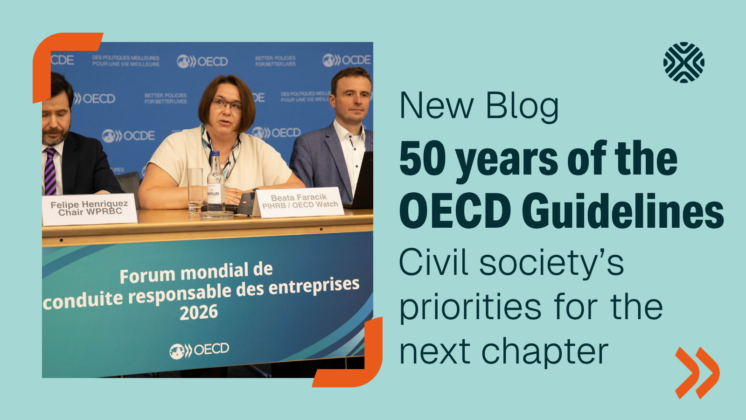
50 anos das Linhas Diretrizes da OCDE: As prioridades da sociedade civil para o próximo capítulo
Na semana passada, a OECD Watch juntou governos, empresas, sindicatos e sociedade civil de todo o mundo em Paris para a Semana de Condução Empresarial Responsável da OCDE, que assinalou o 50.º aniversário das Orientações da OCDE para Multinacionais…
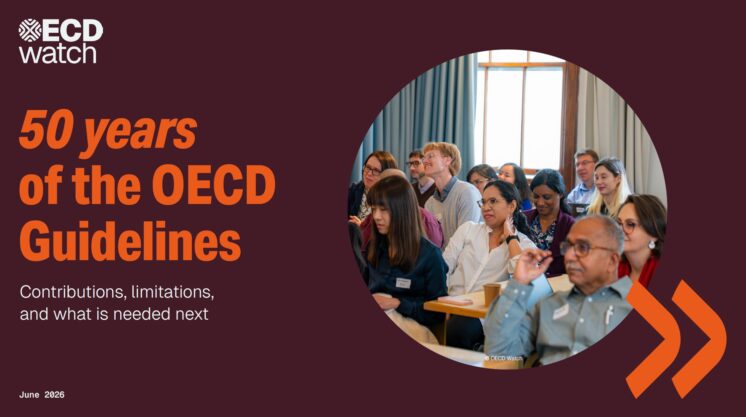
50 anos das Diretrizes da OCDE: contribuições, limitações e o que é necessário a seguir
Recomendações à OCDE e aos governos dos países membros sobre a implementação futura das Diretrizes
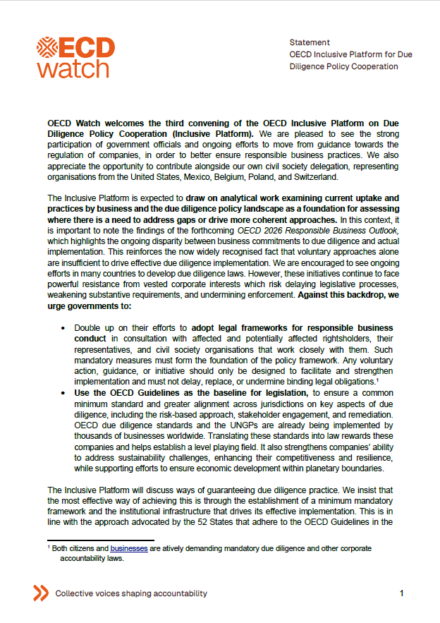
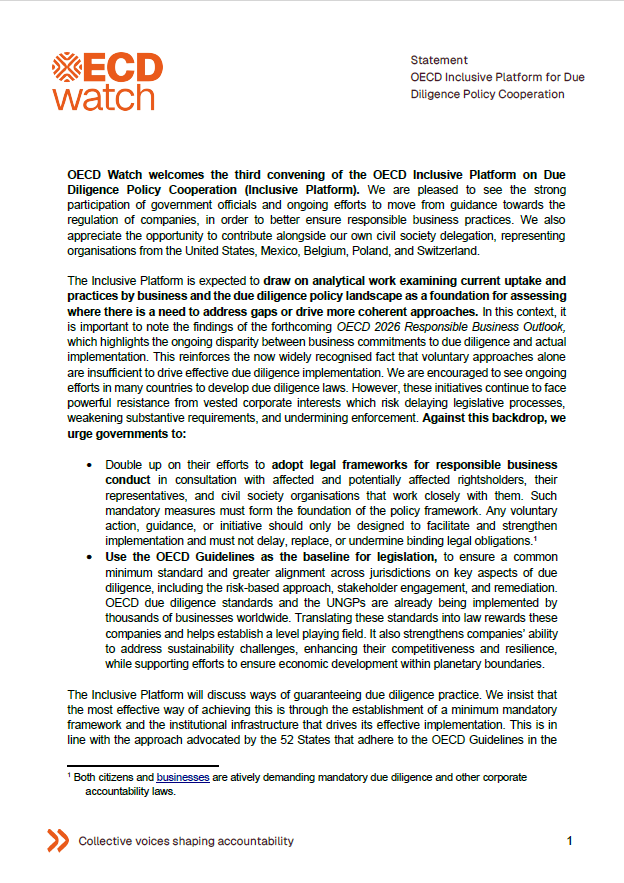
Declaração da OECD Watch sobre o avanço dos frameworks jurídicos para conduta empresarial responsável
Declaração sobre a terceira reunião da Plataforma Inclusiva da OCDE sobre Cooperação em Políticas de Due Diligence
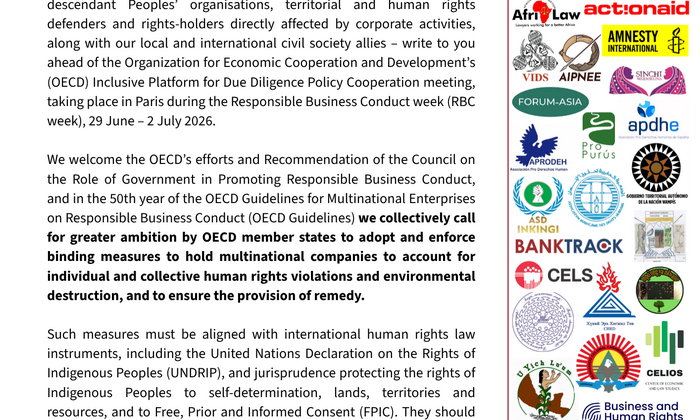
Carta Aberta aos membros do Grupo de Trabalho sobre Conduta Empresarial Responsável da OCDE
O OECD Watch juntou-se a mais de 100 organizações de direitos humanos e ambientais – incluindo organizações representativas de povos indígenas e afrodescendentes – de mais de 55 países, enviando uma Carta Aberta aos membros da…
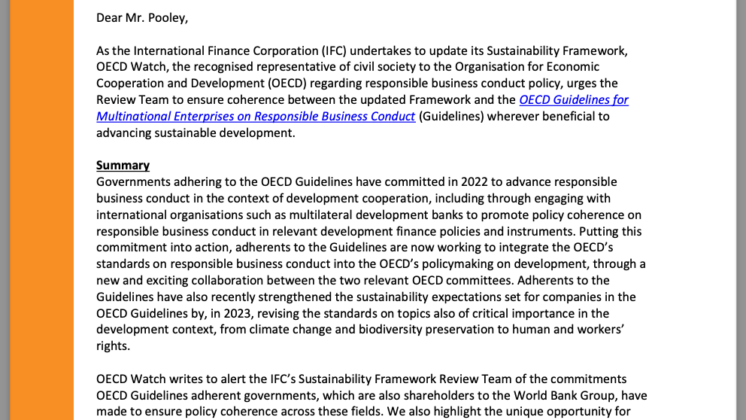
Carta de adesão ao IFC: alinhamento das normas de sustentabilidade com as Diretrizes da OCDE
O OECD Watch enviou uma carta conjunta à International Finance Corporation (IFC) solicitando que a sua Revisão do Quadro de Sustentabilidade seja alinhada com os Direitos da Organização para as Empresas Multinacionais sobre Conduta Empresarial Responsável – elevando a…