


Our work on policy coherence
OECD Watch uses the OECD Guidelines and due diligence guidance to push for corporate accountability standards that protect people and the planet and provide access to remedy when harm occurs.
We guide civil society in filing NCP complaints more strategically. One strategy involves using complaints to highlight gaps in national laws on topics better addressed in the Guidelines. Such claims promote broader policy coherence and can help raise expectations for business conduct.
We advised the OECD’s development of the influential 2022 Recommendation on the Role of Government in Promoting Responsible Business Conduct, which calls on governments to align national policies with the OECD Guidelines. This includes adopting corporate accountability laws, strengthening sustainability standards in public procurement and export credits, and promoting responsible business conduct through trade agreements and development cooperation.
We continue to urge the OECD to better monitor and guide government action in these areas, while working with other OECD bodies to integrate responsible business conduct principles into their policies on export credits, trade and investment, and development cooperation. This helps strengthen policy coherence across the OECD.
We promote alignment between national and regional RBC law and policy and the OECD Guidelines as a baseline. We also urge other bodies whose standards impact corporate conduct - such as the ISSD and multilateral development banks - to seek alignment with the OECD Guidelines wherever applicable.

What the OECD Guidelines say
The OECD Guidelines call for coherence between leading international responsible business conduct standards and national and regional policies. They encourage governments to promote responsible business conduct through a smart mix of voluntary and mandatory measures.
Through the OECD’s Recommendation on the Role of Government in Promoting Responsible Business Conduct and Declaration on Promoting and Enabling Responsible Business Conduct in the Global Economy, many governments have committed to develop legal and policy frameworks that are aligned with the OECD Guidelines.
These standards can be used to advocate for governments to:
- develop laws and policies on responsible business conduct that are aligned with the OECD Guidelines;
- ensure that corporate accountability and due diligence requirements cover the full range of relevant impacts and business relationships;
- use binding measures where needed to prevent and address corporate harms; and
- ensure that National Contact Points and other government mechanisms support effective implementation of responsible business conduct standards.
Get involved
Want to learn more about OECD Watch’s work on this issue? Get in touch with us to find out more about our advocacy and resources, or to discuss how the OECD Guidelines can support your work.
You can also join our civil society working group on due diligence legal and policy developments to connect with organisations working on this issue, exchange knowledge, and contribute to collective advocacy. Reach out to us directly.
Related resources
Policy coherence factsheet
Get a practical overview of what the OECD Guidelines say about advancing coherence across global RBC policy. Available in:
English
Arabic
French
Spanish
Portuguese
Using the OECD Recommendation on the Role of Government in Promoting RBC
Read OECD Watch’s blog on using the Recommendation to encourage governmental progress in advancing RBC through law as well as policy on related topics like procurement, export credits, or development finance.
Related NCP complaints
See complaints in which policy coherence has been raised as an issue filed by civil society.

How to use the Guidelines
The OECD Guidelines provide civil society with a framework for engaging companies, governments and other decision-makers on responsible business conduct. You can use the Guidelines to:
Help communities and other affected people understand the standards companies are expected to meet and the rights and protections they can demand.
Use the Guidelines to talk to companies about their impacts and demand that they prevent, address and remedy harm.
Use the Guidelines to advocate for strong laws, policies and corporate practices that protect people and the planet and hold companies accountable.
When a company falls below the standards in the Guidelines, you can bring a complaint to an NCP and seek accountability and remedy.
Connected issues
Related news and publications
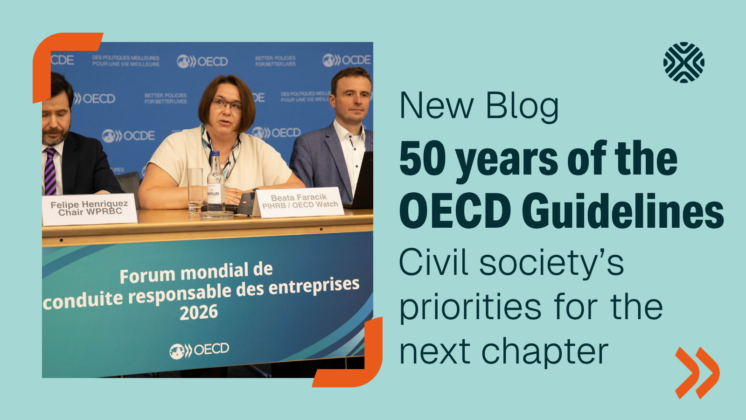
50 years of the OECD Guidelines: Civil society’s priorities for the next chapter
Last week, OECD Watch joined governments, businesses, trade unions and civil society from around the world in Paris for the OECD’s Responsible Business Conduct Week, marking the 50th anniversary of the OECD Guidelines for Multinational…

50 years of the OECD Guidelines: Contributions, limitations, and what is needed next
Recommendations for the OECD and member governments on the future implementation of the Guidelines

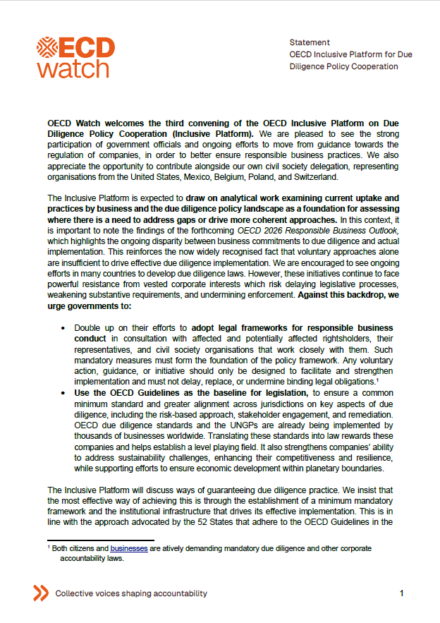
OECD Watch statement on advancing legal frameworks for responsible business conduct
Statement on the third meeting of the OECD's Inclusive Platform on Due Diligence Policy Cooperation
Sign-on Letter to IFC: Align sustainability standards with OECD Guidelines
OECD Watch has sent a joint letter to the International Finance Corporation (IFC) calling for its Sustainability Framework Review to align with the OECD Guidelines for Multinational Enterprises on Responsible Business Conduct – raising the…
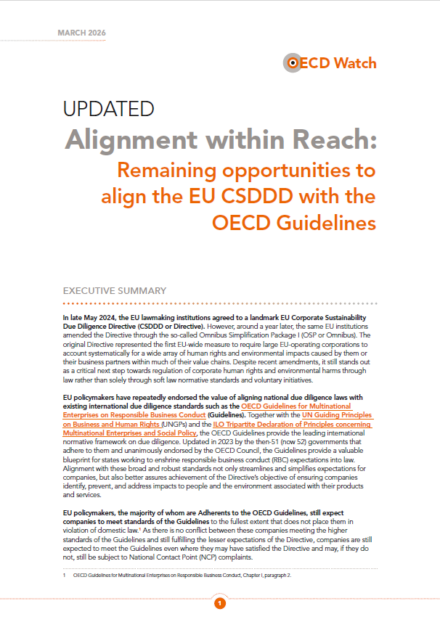
Updated – Alignment within Reach: Remaining opportunities to align the EU CSDDD with the OECD Guidelines
Recommendations for EU policymakers and member states to correct lack of alignment between EU CSDDD and the OECD Guidelines