

What we do
Our work helps connect international standards, emerging policy approaches, and civil society expertise to advance stronger expectations for responsible business conduct. We work collaboratively across the business and human rights field to:
- Build civil society expertise
- Connect standards with policymaking
- Strengthen corporate accountability

Supporting civil society expertise
We help civil society organisations understand and use the OECD Guidelines when engaging in discussions about corporate accountability at national, regional, and multilateral levels.
We provide research, analysis, and expertise on issues such as corporate human rights and environmental due diligence, helping civil society bring evidence and international standards into policy debates.
Connecting standards and policy
We engage with the OECD, governments, and other relevant standard-setting bodies to promote the OECD Guidelines and related instruments as useful reference points for developing and strengthening accountability for business-related harm.
OECD Watch is encouraging other standard setting bodies like the ISSD and multilateral bodies like development banks to drive towards coherence in their policies guiding corporate conduct.
Strengthening corporate accountability
Effective corporate accountability requires more than voluntary commitments.
We work to build understanding on how international standards can inform stronger accountability frameworks. We also support civil society to engage constructively in discussions about how companies should prevent, address, and account for their impacts on people and the planet.
Related resources
OECD Guidelines and corporate accountability law
The OECD Guidelines are increasingly underpinning national and regional law and policy regulating business conduct.
Using the OECD Recommendation on the Role of Government in Promoting RBC
Read OECD Watch’s blog on using the Recommendation to encourage governmental progress in advancing RBC through law as well as policy on related topics like procurement, export credits, or development finance.
50 years of the OECD Guidelines
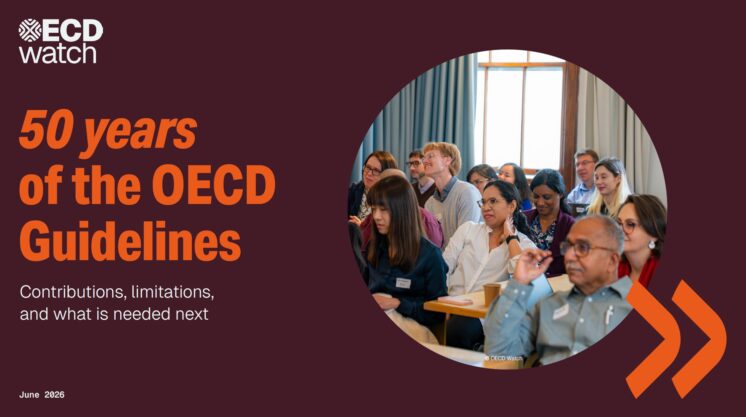
Our report marking 50 years of the OECD Guidelines showcases their contributions and limitations and explores what is needed next. Our key finding is that, to advance the Guidelines’ future impact, we need more state leadership and more binding rules. The onus is on states to translate the voluntary framework into binding law and robust national policy.
Related news and publications
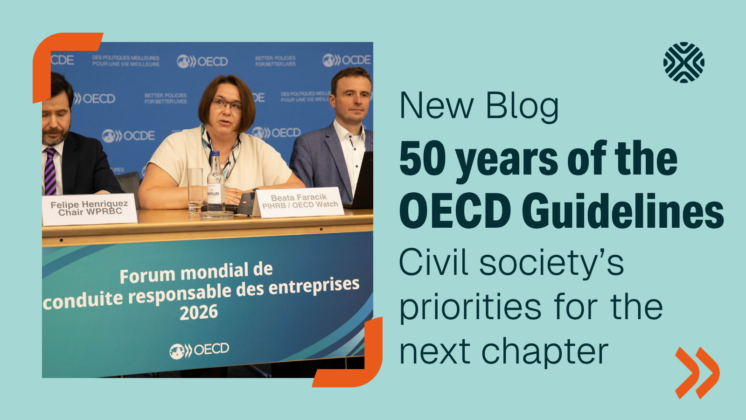
50 years of the OECD Guidelines: Civil society’s priorities for the next chapter
Last week, OECD Watch joined governments, businesses, trade unions and civil society from around the world in Paris for the OECD’s Responsible Business Conduct Week, marking the 50th anniversary of the OECD Guidelines for Multinational…
50 years of the OECD Guidelines: Contributions, limitations, and what is needed next
Recommendations for the OECD and member governments on the future implementation of the Guidelines
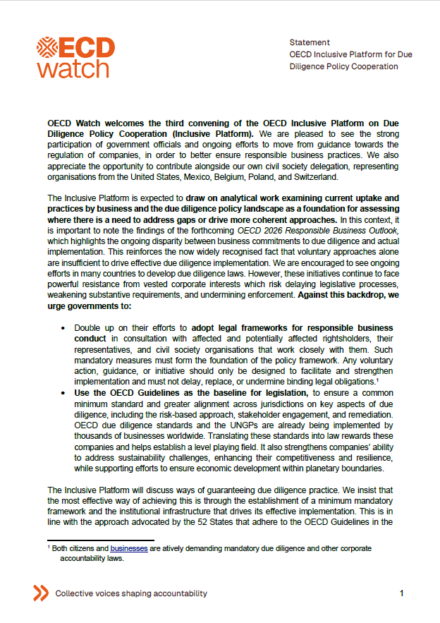
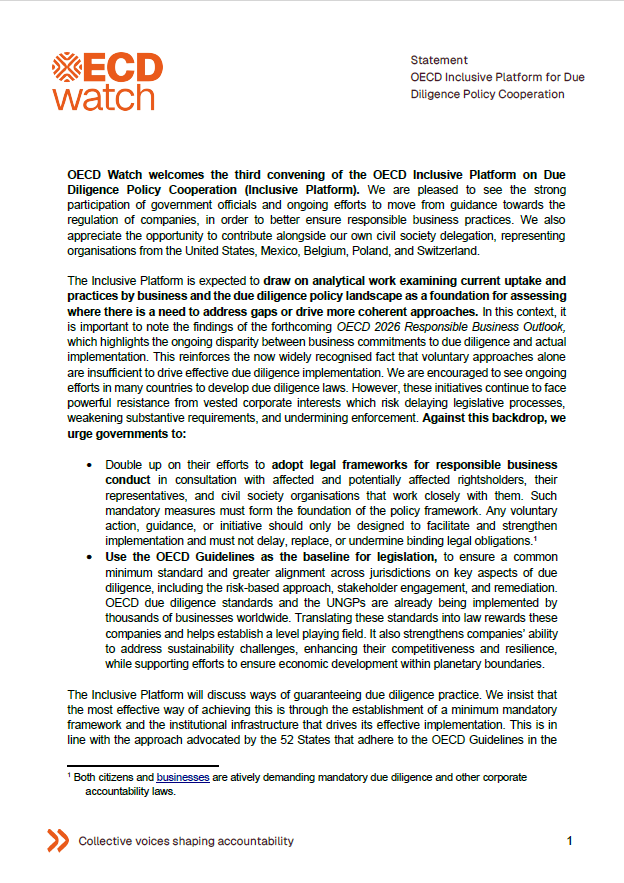
OECD Watch statement on advancing legal frameworks for responsible business conduct
Statement on the third meeting of the OECD's Inclusive Platform on Due Diligence Policy Cooperation
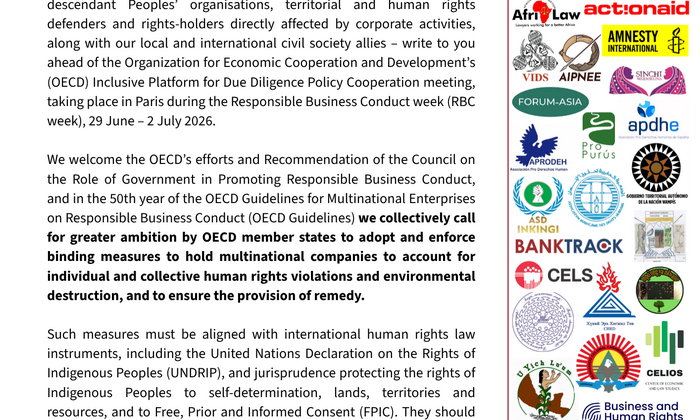
Open Letter to the members of the OECD Working Party on Responsible Business Conduct
OECD Watch has joined over 100 human rights and environmental organisations – including Indigenous Peoples’ and Afro-descendant peoples’ representative organisations – from more than 55 countries in sending an Open Letter to members of the…
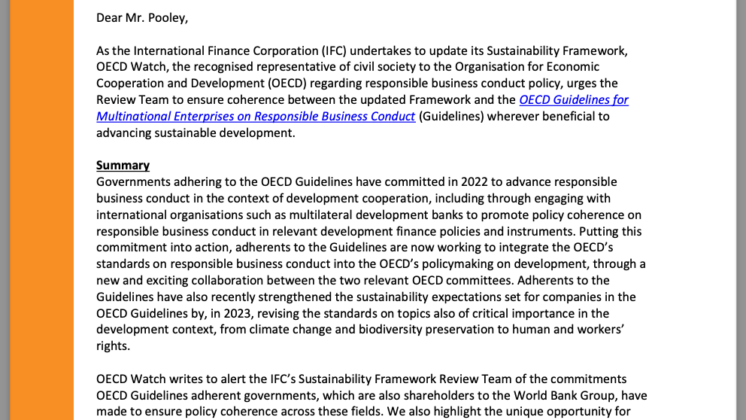
Sign-on Letter to IFC: Align sustainability standards with OECD Guidelines
OECD Watch has sent a joint letter to the International Finance Corporation (IFC) calling for its Sustainability Framework Review to align with the OECD Guidelines for Multinational Enterprises on Responsible Business Conduct – raising the…